No matter what you’re training for, there’s one part of your workout that should never be overlooked: stretching.
At BPM Fitness Centre we believe every workout begins long before your first repetition and continues well after your last. Incorporating the right type of stretching before and after exercise can improve performance, enhance mobility, reduce injury risk, and accelerate recovery—helping you get more from every training session.
If you’ve ever wondered whether stretching actually makes a difference, the answer is yes—but the type of stretching and when you perform it matters.
Why Stretching Before a Workout Is Important
Many people still think warming up means holding a hamstring stretch for 30 seconds before heading straight into squats or a run. Modern sports science has shown that’s not the most effective approach.
Instead, dynamic stretching is the gold standard before exercise.
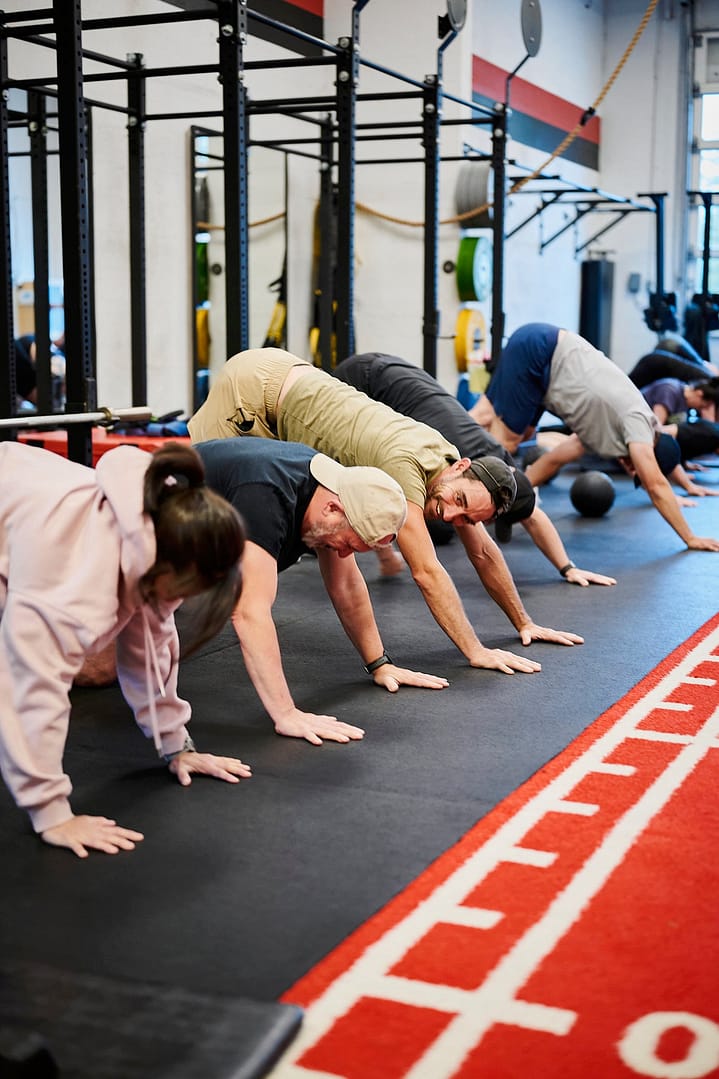
Dynamic stretches involve controlled movements that take your joints and muscles through their full range of motion while gradually increasing heart rate and body temperature.
Examples include:
- Walking lunges
- Leg swings
- Arm circles
- World’s Greatest Stretch
- Bodyweight squats
- High knees
- Hip openers
These movements prepare your body for the demands of exercise by:
- Increasing blood flow to working muscles
- Improving joint mobility
- Activating key muscle groups
- Enhancing balance and coordination
- Improving neuromuscular efficiency
- Raising core body temperature
Whether you’re attending one of our Strength Conditioning, Cross Conditioning, Bootcamp, or HYROX classes, every session at BPM Fitness Centre begins with a purposeful warm-up designed to prepare your body—not just tire you out.
Dynamic Stretching Can Improve Performance
One of the biggest benefits of dynamic stretching is improved athletic performance.
Research consistently shows that athletes who perform movement-based warm-ups often experience improvements in:
- Sprint speed
- Jump height
- Power production
- Agility
- Running mechanics
- Force production
Preparing the nervous system before exercise helps muscles contract more efficiently, allowing you to move better and produce more power.
If your goal is to perform your best, warming up correctly is part of the training—not something separate from it.
Why Static Stretching Is Better After Your Workout
After exercise, your body has different needs.
This is where static stretching becomes beneficial.
Static stretching involves holding a stretch for approximately 20–60 seconds without bouncing.
Examples include:
- Hamstring stretch
- Hip flexor stretch
- Calf stretch
- Chest doorway stretch
- Figure-four glute stretch
- Child’s Pose
- Quadriceps stretch
Following training, static stretching may help restore muscle length, improve flexibility over time, reduce any feelings of muscle tightness, among others.
While stretching won’t magically eliminate delayed onset muscle soreness (DOMS), it can help many people feel less stiff and improve overall mobility between workouts.
Better Mobility Leads to Better Training
One of the most overlooked benefits of stretching is how it contributes to long-term mobility.
Mobility is your ability to move a joint through its full range of motion with control.
Poor mobility can affect nearly every exercise. It often causes compensations elsewhere in the body, increasing unnecessary stress on joints and connective tissue.
At BPM Fitness Centre, our coaches regularly incorporate mobility work into warm-ups, movement preparation, and cool-downs to help members move more efficiently.
Better movement often leads to:
- Better lifting technique
- Improved running mechanics
- More efficient movement
- Greater confidence
- Reduced injury risk
- Improved exercise quality
Stretching Supports Recovery
Recovery is where progress actually happens.
Training creates stress and recovery allows your body to adapt.
Stretching after exercise is one tool that complements a complete recovery strategy alongside:
- Adequate sleep
- Proper nutrition
- Hydration
- Active recovery
- Massage therapy
- Strength programming
BPM Fitness Centre also offers Contrast Therapy sessions for members who wish enhance recovery by alternating between sauna and cold plunge—the benefits of which can be found, here.
Stretching Alone Won’t Prevent Every Injury
One common misconception is that stretching completely prevents injuries.
The reality is more nuanced.
Injury prevention depends on multiple factors, including:
- Progressive strength training
- Proper technique
- Training load management
- Recovery
- Sleep
- Mobility
- Individual biomechanics
Stretching is one important piece of the puzzle—not the entire solution.
That’s why our coaches focus on movement quality, strength development, individualized programming, and proper exercise progression.
If movement limitations are affecting your training, our Running Performance Assessment or Personal Training assessments can identify mobility restrictions, muscular imbalances, and movement inefficiencies before they become larger problems.
Stretch Smarter at BPM Fitness Centre
At BPM Fitness Centre, stretching isn’t treated as an afterthought.
It’s built into our coaching philosophy because we know that moving well is just as important as training hard.
By combining dynamic stretching into the program, you’ll improve movement quality, optimize performance, support recovery, and build a body that’s ready for the next workout.
If you’re ready to train smarter—not just harder—our experienced coaching team is here to help.
References
- Afonso, J., Clemente, F. M., Nakamura, F. Y., Morouço, P., Sarmento, H., Inman, R. A., & Ramirez-Campillo, R. (2021). The effectiveness of post-exercise stretching in short-term and delayed recovery of strength, range of motion and delayed onset muscle soreness: A systematic review and meta-analysis of randomized controlled trials. Frontiers in Physiology, 12, 677581. https://doi.org/10.3389/fphys.2021.677581
- Konrad, A., Tilp, M., & Nakamura, M. (2021). A comparison of the effects of foam rolling and stretching on physical performance: A systematic review and meta-analysis. Frontiers in Physiology, 12, 720531. https://pubmed.ncbi.nlm.nih.gov/34658909/
- Takeuchi, K., Nakamura, M., Konrad, A., et al. (2025). Acute effects of dynamic and ballistic stretching on flexibility: A systematic review and meta-analysis. Journal of Sports Science & Medicine. https://pubmed.ncbi.nlm.nih.gov/40469856/