
Whether you’re strength training, running, competing in HYROX, playing recreational sports, or simply trying to improve your overall fitness, nutrition matters just as much as your training program. You can have a great workout routine, but if you consistently under-fuel your body, performance, recovery, and energy can suffer.
At BPM Fitness Centre, we see people training at every level — from recreational exercisers to competitive athletes. One of the most important questions for anyone increasing their training volume is also one of the most misunderstood:
How much should you actually be eating when you train hard?
Calorie requirements aren’t one-size-fits-all. Men and women can have different average energy needs, but sex is only one piece of the equation. Body size, muscle mass, age, daily activity, training volume, sport, and individual physiology all influence how much energy you need.
Calories Are Fuel — Not Something to Fear
A calorie is simply a unit of energy. Your body uses energy to support basic physiological functions, daily movement, recovery, and exercise.
When you strength train, run, attend fitness classes, practice a sport, or prepare for a competition, your energy requirements increase. If you consistently consume less energy than your body requires, you may experience poor recovery, lower energy, reduced training quality, difficulty concentrating, or declining performance.
This is particularly important when you’re training hard. More exercise doesn’t necessarily mean you should eat less. Increasing your training volume often means paying more attention to adequate energy intake and sports nutrition.
How Many Calories Do Active Men and Women Need?
There is no single calorie target that applies to every active man or woman.
As a broad reference, general dietary guidelines estimate that active adult women may require roughly 2,000–2,400 calories per day, depending on age, while active adult men may require approximately 2,400–3,000+ calories per day. These estimates are for general activity and aren’t necessarily sufficient for someone completing demanding athletic training.
Athletes can require considerably more.
Research examining collegiate athletes has used approximate energy recommendations of 40 kcal/kg/day for lower activity, 50 kcal/kg/day for moderate activity, and 60 kcal/kg/day for high activity. That means a 70 kg (154 lb) athlete could theoretically require approximately 2,800–4,200 calories per day, depending on training demands.
Real-world research demonstrates why individualized recommendations are so important. Studies of female athletes have reported average daily energy expenditures around 2,300 calories in varsity ice hockey players, approximately 2,700 calories in international soccer players, and nearly 2,900 calories in professional football players.
Rather than thinking:
“Women need X calories and men need Y calories,”
a better question is:
“Am I eating enough to support what I’m asking my body to do?”
Proper Nutrition for Training Hard
When you’re training consistently, your nutrition should help you perform, adapt, and recover.
Persistent low energy, difficulty recovering between workouts, declining performance, unusual irritability, difficulty concentrating, or excessive hunger around training can all be reasons to take a closer look at your nutrition.
These signs aren’t automatically proof that you need more calories, but they’re worth paying attention to — particularly when your training volume has recently increased.
If you’re regularly attending BPM group fitness classes, working with a personal trainer, running, or training for a competitive event, your nutritional requirements may be significantly different from someone exercising once or twice per week.
What Should You Eat When Training Hard?
Total calories matter, but where those calories come from matters too.
Carbohydrates are an important fuel source for moderate- and high-intensity exercise. Foods such as oats, rice, potatoes, fruit, pasta, and whole grains can help provide energy for demanding training sessions.
Protein supports muscle repair, maintenance, and adaptation. Rather than trying to consume all your daily protein in one meal, spreading protein-containing foods throughout the day can be a practical approach for active individuals.
Dietary fats also provide energy and support normal physiological functions. Unless medically necessary, there’s generally no reason for an athlete to fear or completely eliminate one of the major macronutrients.
And don’t forget hydration. Longer workouts, running, HYROX training, team sports, and outdoor activity can all increase fluid requirements. Starting exercise adequately hydrated and replacing fluids throughout the day can support both performance and recovery.
For more individualized support, BPM offers nutrition services to help active people better understand how their nutrition can complement their training.
Fuel Your Sport — Not Just Your Workout
Sports training can create energy demands well beyond the hour you spend in the gym.
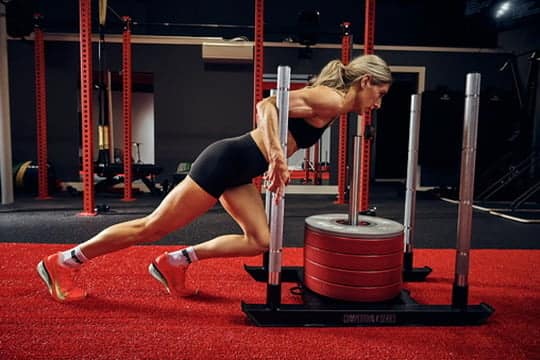
A runner may combine several weekly runs with strength training. A HYROX athlete may need to recover from running, sled work, rowing, SkiErg training, and strength sessions. A recreational athlete may play their sport several times per week while also attending the gym.
All of that activity requires energy.
This is why sports nutrition should account for your entire training week, rather than treating every day exactly the same. Harder training days may require more overall food and carbohydrates, while recovery days may have different demands.
Consistently under-fuelling while trying to increase your training load can work against the very adaptations you’re trying to achieve.
Train Hard. Recover Hard. Fuel Accordingly.
At BPM Fitness Centre, we believe performance is about more than what happens during your workout. Strength, conditioning, mobility, recovery, sleep, hydration, and proper nutrition all contribute to your ability to train consistently and perform at your best.
Whether you’re preparing for a race, HYROX competition, recreational sport, or simply pushing yourself harder in the gym, remember that food isn’t the enemy of your fitness goals — it’s part of what allows you to pursue them.
Instead of automatically trying to eat less when you increase your exercise, focus on eating enough nutritious food to support your training, recovery, health, and performance.
Need help figuring out how your nutrition and training should work together? Contact BPM Fitness Centre to learn more about our personal training and nutrition services in Victoria, BC.
References
- Logue, D. M., et al. (2020). Reasons for and consequences of low energy availability in female and male athletes: Social environment, adaptations, and prevention. Sports Medicine, 50, 73–96. https://pubmed.ncbi.nlm.nih.gov/32910256/
- Logue, D. M., Madigan, S. M., Melin, A., Delahunt, E., Heinen, M., Mc Donnell, S.-J., & Corish, C. A. (2020). Low energy availability in athletes 2020: An updated narrative review of prevalence, risk, within-day energy balance, knowledge, and impact on sports performance. Nutrients, 12(3), 835. https://pubmed.ncbi.nlm.nih.gov/32245088/
- Bentley, M. R. N., et al. (2022). Nutrition for female athletes: What we know, what we don’t know, and why. European Journal of Sport Science, 22(5), 669–671.
DOI: 10.1080/17461391.2022.2046176 https://pubmed.ncbi.nlm.nih.gov/35195492/