Running is one of the most accessible and effective forms of exercise – but it’s also one of the most misunderstood. Many runners assume that logging more kilometers leads to better performance. In reality, how you run matters just as much as how much you run.
That’s where the BPM Performance+ Running Assessment comes in.
Designed to bridge the gap between effort and efficiency, this assessment takes a deep dive into your running mechanics, movement patterns, and performance potential – helping you move better, reduce injury risk, and unlock your true capacity.
What Is a Running Assessment (and Why It Matters)
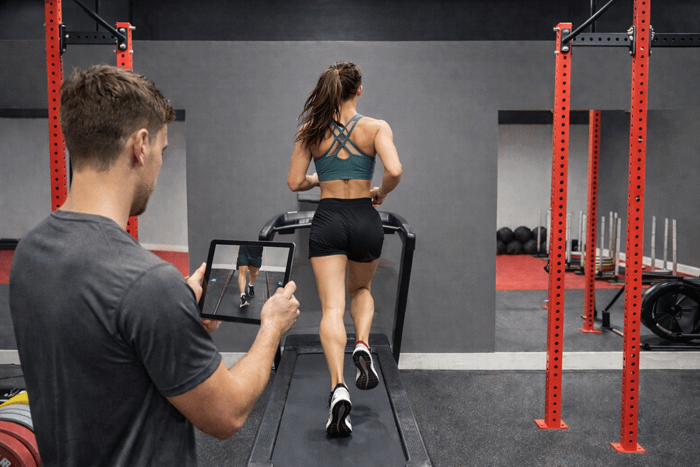
A running assessment – often referred to as a gait or biomechanical analysis – evaluates how your body moves during running. This includes your stride, foot strike, joint angles, posture, and overall coordination.
Using tools like video analysis and movement screening, experts can identify inefficiencies and compensations that often go unnoticed by the naked eye.
Research shows that quantitative gait analysis is a valuable tool for both performance optimization and injury risk assessment, making it highly relevant for both recreational and competitive runners.
At BPM, this concept is elevated through the Performance+ approach, combining biomechanics, coaching insight, and individualized programming into one actionable experience.
Why Most Runners Plateau (or Get Injured)
Running is repetitive. Very repetitive.
Over time, even small inefficiencies in movement – like overstriding, poor hip stability, or improper foot strike – can compound into performance limitations or injuries.
Common issues include:
- Knee pain (patellofemoral syndrome)
- Shin splints
- Plantar fasciitis
- Hip or lower back discomfort
Many of these stem from faulty mechanics and load distribution, which can be identified and corrected through proper analysis.
In fact, studies suggest that analyzing running patterns can help detect movement patterns linked to injury risk, allowing for earlier intervention and smarter training decisions.
The Performance Edge: What the BPM Assessment Looks At
The BPM Performance+ Running Assessment goes beyond just watching you move. It evaluates the entire system contributing to your movement.
1. Running Mechanics
- Foot strike pattern (heel, midfoot, forefoot)
- Stride length and cadence
- Ground contact time
2. Biomechanics & Alignment
- Hip stability and knee tracking
- Postural positioning
- Arm swing efficiency
3. Mobility & Strength Limitations
- Ankle mobility
- Hip range of motion
- Core stability
4. Efficiency & Running Economy
Running economy refers to how much energy you use at a given pace. The more efficient you are, the faster (and longer) you can run with less effort.
Advanced assessments capture data like:
- Stride efficiency
- Force production
- Energy transfer
These factors are critical, as improved mechanics can reduce energy expenditure and enhance performance output
Who Is This For?
The BPM Performance+ Running Assessment is for:
- Beginners wanting to start running properly
- HYROX athletes looking to improve race performance
- Runners dealing with recurring injuries
- Anyone chasing faster times or better endurance
Research supports that runners of all levels benefit from gait analysis, from injury prevention to performance enhancement.
Running more isn’t always the answer.
Running better is.
The BPM Performance+ Running Assessment gives you the tools, insight, and strategy to:
- Move efficiently
- Stay injury-free
- Perform at your highest level
Whether you’re chasing your first 5K or your next HYROX PR, this is how you take your running to the next level.
References
Fife, A., et al. (2025). Running shoe recommendations based on gait analysis and their effects on comfort and performance. Journal of Sports Science & Medicine.
Mason, R., et al. (2023). Wearables for running gait analysis: A study protocol. Journal of Sports Engineering and Technology.
Tripodi, N. (2024). Introduction to running analysis in the clinical setting. Journal of Foot and Ankle Research.
Abramowitz, E. (2025). How gait and running analysis enhances athletic performance.
Hospital for Special Surgery. (2024). Running gait analysis: What to expect and benefits.
UFIT. (2024). Gait analysis benefits and expectations.