You notice strength in everyday moments. It’s there when you carry groceries up the stairs, get up from the garden without reaching for support, or lift your suitcase into the overhead bin. Keeping those tasks manageable is one of the best reasons to keep strength training as older adults. And if you’ve never lifted weights before, you can start building that capacity now.
We recently brought the conversation about active aging to local readers in BPM Fitness Centre’s sponsored Times Colonist feature, A Stronger Approach to Healthy Aging. Here, we’ll look more closely at sarcopenia, what resistance training can do about it, and how to get started at our gym in Victoria, BC.
What is sarcopenia, and why does it matter?
Sarcopenia is a muscle disorder associated with aging. Low muscle strength is a key sign, and clinicians also assess muscle quantity or quality to confirm the diagnosis. Its effects can show up in familiar ways, like needing your hands to rise from a chair or finding that a flight of stairs takes more effort than it used to. If you notice a new or unexplained decline in strength, bring it up with a healthcare professional.
Small changes in strength can influence how you spend your day. When getting up from a low seat or carrying a bag feels harder, it’s easy to start avoiding those tasks. Regular strength training gives you a structured way to keep challenging the muscles you rely on for daily life.
How does resistance training help counter sarcopenia?
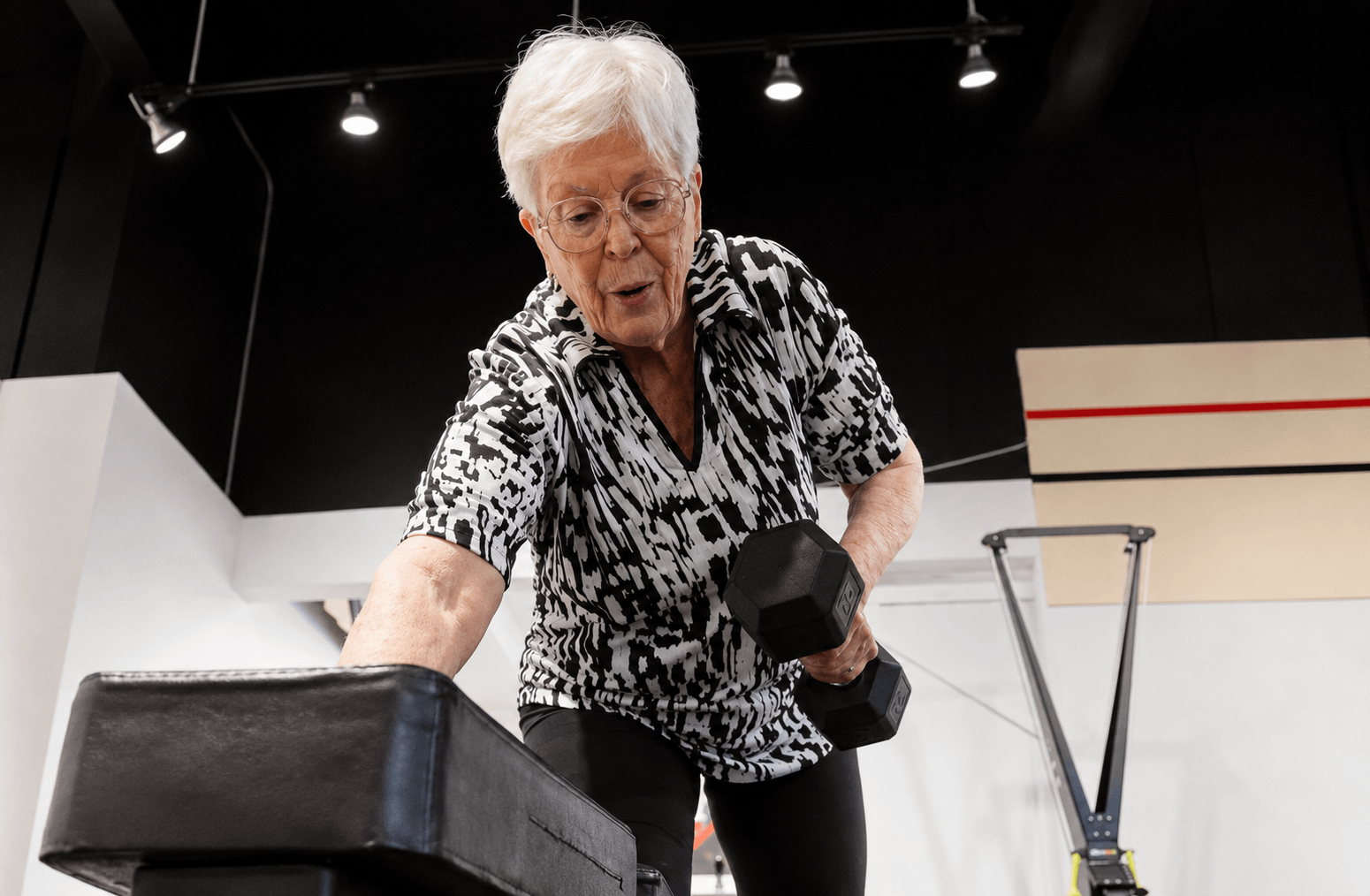
Resistance training makes your muscles work against a load. That load can come from dumbbells, resistance bands, or your own body weight. In progressive resistance training, you gradually increase the challenge as you adapt. You might start by standing up from a bench, build up to more controlled repetitions, then add a light dumbbell when you’re ready.
A systematic review of 24 randomized trials found that older adults with sarcopenia who did resistance training improved measures such as grip strength, walking speed, and the ability to stand from a chair repeatedly. Changes in muscle size were less consistent. That makes it worth tracking what you can do. Rising from a chair more easily or carrying the same groceries with less effort can be meaningful progress.
What does functional strength look like outside the gym?
Start with something you want to keep doing. If you love walking at Thetis Lake, step-ups give you a way to practise pushing through one leg at a time, much like you do when climbing a trail. Hip hinges can help if you want to keep gardening without struggle. If your goal is to handle your own luggage, loaded carries let you work on grip strength and practise walking while holding weight.
Balance deserves time in your routine, too. Canadian movement guidelines for adults 65 and older recommend activities that challenge balance alongside muscle-strengthening and aerobic activity. That could mean pairing your usual walks and gym sessions with exercises such as standing heel-to-toe near a stable support.
How often should older adults strength train?
The Canadian 24-Hour Movement Guidelines recommend working the major muscle groups at least twice a week for adults aged 65 and older. If you’re starting from scratch or returning after time away, build toward a routine that fits your current ability and schedule. Two sessions on separate days can be a practical starting point. Your first few weeks might focus on learning a handful of movements and finding a level of resistance you can handle with control.
Progress can look like doing another repetition, using a little more weight, or getting up from a slightly lower bench. If you already lift, you can keep training while adjusting exercise selection, volume, or recovery as your needs change. The right plan gives you a challenge you can recover from and repeat consistently.
Where can you start strength training in Victoria, BC?
At BPM Fitness Centre in Saanich, we offer personal training for older adults for people who want one-on-one coaching. Your trainer can help you choose exercises and resistance based on your experience, your comfort level, and what you want to do more easily outside the gym. If you’re new to lifting, that might mean learning how to pick up a weight from the floor or finding a squat variation you feel comfortable practising.
If you enjoy training with other people, our 60-minute Strength Conditioning classes combine coached lifting, exercise technique, and structured progression. You can see upcoming sessions on the BPM class schedule.
Think of one thing you’d like to keep doing five or ten years from now, whether that’s hiking with friends, travelling independently, or playing on the floor with your grandkids. Bring that goal when you get in touch with BPM Fitness Centre. It’s a starting point for building a strength routine that fits your life.
References
- Cruz-Jentoft, A. J., Bahat, G., Bauer, J., Boirie, Y., Bruyère, O., Cederholm, T., Cooper, C., Landi, F., Rolland, Y., Sayer, A. A., Schneider, S. M., Sieber, C. C., Topinkova, E., Vandewoude, M., Visser, M., Zamboni, M., & Writing Group for the European Working Group on Sarcopenia in Older People 2 (EWGSOP2), and the Extended Group for EWGSOP2 (2019). Sarcopenia: revised European consensus on definition and diagnosis. Age and ageing, 48(1), 16–31. https://pmc.ncbi.nlm.nih.gov/articles/PMC6322506/
- Yan, R., Chen, Y., Zhang, R., He, J., Lin, W., Sun, J., & Li, D. (2025). Optimal resistance training prescriptions to improve muscle strength, physical function, and muscle mass in older adults diagnosed with sarcopenia: a systematic review and meta-analysis. Aging clinical and experimental research, 37(1), 320. https://pubmed.ncbi.nlm.nih.gov/41212331/
- Keating, C. J., Cabrera-Linares, J. C., Párraga-Montilla, J. A., Latorre-Román, P. A., Del Castillo, R. M., & García-Pinillos, F. (2021). Influence of Resistance Training on Gait & Balance Parameters in Older Adults: A Systematic Review. International journal of environmental research and public health, 18(4), 1759. https://pubmed.ncbi.nlm.nih.gov/33670281/